Winter Came Early
About the Book
Winter Came Early
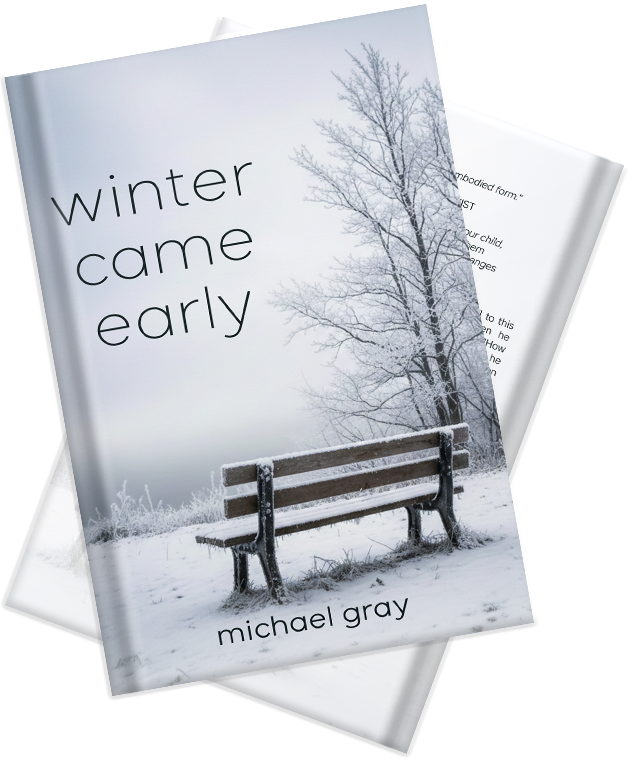
In Winter Came Early, Michael Gray transforms lived experience into a deeply intimate memoir told with the emotional cadence of a novel. The book invites readers into the aftermath of a father’s unimaginable loss — the death of his son — and explores what it means to continue living when the world you once understood has irrevocably changed.
Rather than recounting grief as a distant chapter in the past, Gray writes from inside its ongoing presence. Memory arrives in fragments — moments of tenderness, flashes of regret, echoes of love — mirroring how mourning truly unfolds in the human mind. These reflections create a narrative that feels less like a timeline and more like an emotional landscape, where the past and present continually speak to one another. Readers are not simply told about loss; they are invited to sit beside it, to witness how it reshapes identity, perception, and the fragile architecture of meaning.
What makes Winter Came Early especially powerful is its refusal to simplify pain. Gray does not position himself as someone who has neatly resolved his suffering. Instead, he writes with an honesty that is disarming in its clarity — confronting guilt, unanswered questions, and the persistent longing that accompanies love after loss. This vulnerability lends the memoir an immediacy that feels conversational and human, as though the author is trusting the reader with thoughts often left unspoken.
Yet the book is not defined solely by sorrow. Running beneath the grief is a quiet exploration of endurance — how connection survives absence, how memory becomes both burden and refuge, and how meaning is sometimes found not in explanation, but in presence. Gray reflects on the paradox of mourning: that it isolates us even as it reveals our shared humanity. In this way, the memoir becomes a bridge between personal tragedy and universal experience, reminding readers that grief, while deeply individual, is also profoundly communal.
Nature and time act as subtle companions throughout the narrative. Seasonal imagery echoes the emotional terrain, reinforcing winter as both a metaphor for stillness and a necessary phase in a larger cycle of becoming. Within this framework, Gray suggests that transformation does not come from escaping pain, but from learning to live alongside it — allowing sorrow to deepen compassion, awareness, and connection.
Ultimately, Winter Came Early is a meditation on love that endures beyond physical presence. It speaks to anyone who has faced profound loss, not by offering easy comfort, but by bearing witness to the complexity of grief with grace and humility. Gray’s prose honors mourning as an extension of love itself — a testament to the bonds that shape us and continue to define us even in absence, making the memoir both intensely personal and quietly universal.