Asleep at the Wheel of Time
About the Book
Asleep at the Wheel of Time
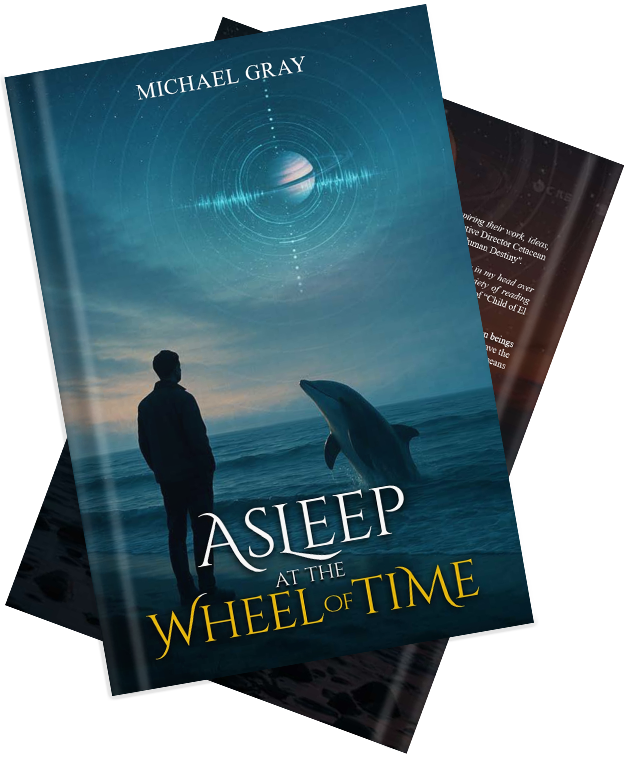
In Asleep at the Wheel of Time, Michael Gray introduces what seems like a familiar science-fiction premise — humanity’s first contact with extraterrestrial intelligence — only to reveal that the encounter is part of a far older conversation unfolding beyond human awareness. When a massive comet is discovered on a collision course with Earth, the warning arrives in an unexpected form: encoded within humpback whale song. The message forces humanity to confront a startling possibility — that communication has been happening for millennia, just not with us at the center.
This revelation reframes the crisis from a purely cosmic threat into a challenge of perception. Alien beings have long recognized whales and dolphins as participants in an ancient dialogue, treating them as intelligent equals while humanity remains largely unaware of the depth of consciousness sharing its own planet. The urgency of the comet exposes more than physical danger; it reveals the limits of human assumptions and the consequences of dismissing voices that do not speak our language.
Gray grounds these sweeping ideas in a personal story centered on two brothers whose strained relationship mirrors the novel’s broader tensions. Their alienation reflects patterns of pride, misunderstanding, and emotional distance — dynamics that echo humanity’s disconnect from the living world around it. As the comet approaches, their conflict becomes more than a subplot; it becomes a human-scale reflection of the larger struggle to recognize, reconcile, and listen across boundaries.
The novel weaves speculative imagination with ecological awareness, positioning interspecies communication as both plot engine and philosophical inquiry. By placing cetaceans at the center of the unfolding events, Gray challenges the belief that intelligence is exclusively human. The story invites readers to reconsider hierarchy, empathy, and the cost of ignoring forms of knowledge that exist outside familiar frameworks.
Moments of tension are balanced with reflective passages that deepen the narrative rather than slowing it. The looming comet drives urgency, while the characters’ evolving awareness adds emotional weight. Gray’s prose blends wit, contemplation, and vivid imagery, allowing the science-fiction elements to feel immediate and grounded in lived experience rather than abstract speculation.
As personal conflict and planetary stakes converge, the novel becomes a meditation on listening — to each other, to the natural world, and to perspectives that challenge human certainty. The threat from the sky serves as a catalyst for awakening, pushing characters to question long-held assumptions and redefining intelligence as something relational rather than hierarchical. Through this lens, the story explores what becomes possible when humanity learns to engage with a wider web of consciousness already in conversation around it.